The 7 Lease Clauses I Write Into Every $30K+ Atherton Rental
Standard CAR leases don't handle a wine cellar, an art collection, a pool, or a smart home. The 7 clauses I write into every $30K+ Atherton, Palo Alto, and Los Altos Hills rental.
A Palo Alto owner emailed me a generic California Association of Realtors residential lease last month and asked me to "tweak it" for his $34,000-a-month rental. I told him no. Then I sat down and drafted what I actually use, line by line, and explained why none of the standard CAR boilerplate fits a property like his.
I've been managing luxury rentals on the Peninsula for 12 years across Atherton, Palo Alto, Los Altos Hills, Woodside, Portola Valley, Hillsborough, and Menlo Park. The leases I sign for $25,000-$60,000 a month rentals run between 30 and 50 pages. They don't look like the residential lease your agent printed off MLS, and they shouldn't.
Here are the seven clauses I never sign without.
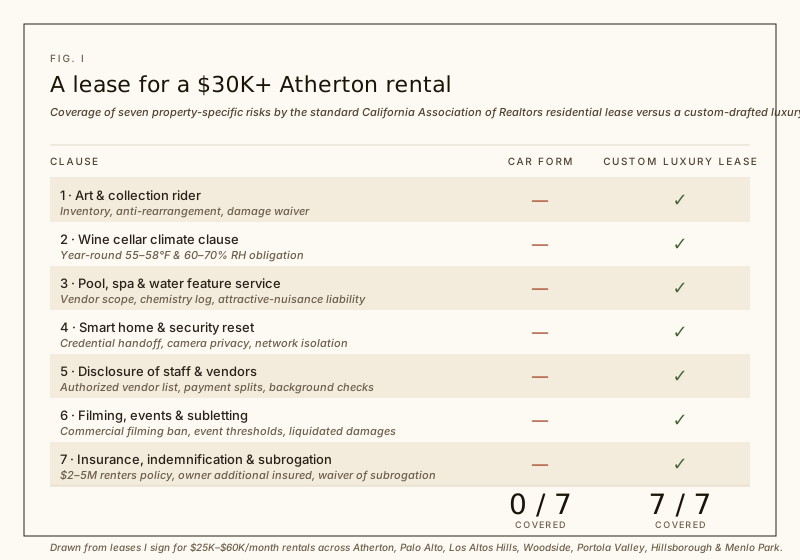
1. Art and collection rider
If the property is delivered with permanent art installations, museum-quality pieces, or seller-furnished collections (wine, sculpture, design furniture), the lease has to specify what stays, what goes, and who's liable if something walks. The CAR boilerplate just says "personal property" and leaves the question wide open.
What I write in: an itemized inventory at move-in with appraisals where relevant, a clause that says the tenant can't move or rearrange specified pieces without written consent, and a separate damage waiver structure for the protected items. Often the owner's fine-art insurance keeps coverage on the pieces during the tenancy, but the lease has to acknowledge that.
I had a tenant in 2023 who decided to "redecorate" by moving a $40,000 sculpture from the foyer to a guest bedroom. The piece was fine. But when he moved out, the floor under it had a settled depression from the weight. Without the rider, the conversation about who pays gets ugly.
2. Wine cellar climate clause
Most $5M+ Peninsula homes have a wine cellar. Many have a cellar plus a humidor. Both need climate control to specific specs, typically 55-58°F and 60-70% humidity. The HVAC system that controls them is separate from the main house climate system.
What I write in: a tenant obligation to keep the cellar climate system operating year-round at the manufacturer's spec, a quarterly maintenance check by an owner-approved vendor at tenant cost, and a damage clause covering the owner's wine inventory if the tenant tampers with the system. If the tenant brings their own collection, there's also a separate addendum covering whose wine is whose at the end of the lease.
This sounds picky. It's not. A wine cellar climate failure on a 1,000-bottle inventory isn't a $4,000 problem. It's a $400,000 problem.
3. Pool, spa, and water feature service
Standard CAR leases say the tenant maintains the property "in a tenantable condition." That's useless when there's a pool, a spa, a koi pond, and a fountain.
What I write in: required weekly service by a licensed vendor, owner-approved or owner-direct (so the bill comes to the owner, who keeps records), a chemical-balance log for the pool, and a clear scope on what the tenant is responsible for (debris in the spillway, replacing a torn pool cover) versus the vendor (chemistry, equipment, filter changes).
The trickiest piece is liability. California law treats pools as attractive nuisances. The lease has to say who's responsible if a guest of the tenant gets hurt, and the tenant's renters insurance has to name the owner as additional insured with a minimum limit. I generally require $2 million. The contract layer matters, and the operational layer matters more; I broke down the inspection-log, insurance-rider, and dispatch protocol I run on every Peninsula property with a pool or spa.
4. Smart home and security reset
Every Atherton or Palo Alto luxury home I lease has a smart home stack: Lutron lighting, Sonos audio, Crestron or Savant control, networked cameras, an Alarm.com or Honeywell security system, automated shades, often a Tesla Powerwall and a fully integrated EV charging system. Some have facial-recognition entry.
What I write in: a clean handoff at move-in (owner credentials revoked, tenant credentials provisioned), a reset obligation at move-out (tenant credentials revoked, owner regains full admin), and a clause that prohibits the tenant from adding their own networked equipment to the owner's protected network without written approval. I also include a privacy clause: cameras outside the property recording tenant activity get specific disclosure, cameras inside get disabled or removed entirely.
Without this clause, you end up with the tenant's contractor's wife's nephew having admin access to the front-gate camera six months after the tenancy ends. I've seen it.
5. Disclosure of staff and vendors
A $30,000-a-month rental usually has people on it. Gardener, pool service, weekly cleaner, sometimes a personal chef or estate manager who came with the property.
What I write in: a list of authorized vendors at move-in (the ones the owner already pays), a clause about who pays for what (typically gardening and pool stay with the owner, cleaning shifts to the tenant), and notice requirements for the tenant changing or adding staff. Since August 2026 I've added one more line to the gardening side of that split, because Zone 0 compliance on a leased estate is an owner obligation the tenant can unknowingly break by stacking firewood in the wrong place. If the owner's relationship with the gardener is 12 years deep and the tenant fires them in week three, that's a problem the lease should anticipate.
I also write in a background check requirement for any vendor the tenant brings on-property who'll have keys or codes. Most CAR boilerplate doesn't even contemplate this. The employment side of that question, including who carries workers' compensation exposure for the people working on the property, is covered in the household staff post.
6. Use restrictions: filming, events, short-term subletting
Atherton and Los Altos Hills both restrict short-term rentals. So do most HOA-governed Peninsula neighborhoods. A tenant who's paying $40,000 a month sometimes thinks they can offset it by hosting a film shoot, throwing a paid event, or quietly listing a guest house on Airbnb.
What I write in: an explicit prohibition on commercial filming, a clear definition of "private event" (over X guests requires owner notice and may trigger an additional rider), and an absolute ban on subletting or any form of paid third-party occupancy. With teeth, typically a liquidated damages provision on top of lease termination. One refinement I've made since: an absolute ban on assignment gives up the California remedy that lets you keep a lease alive if the tenant walks, so I now permit assignment subject to written, reasonable standards. The reasoning is here.
This isn't paranoid. Two of my owners have had tenants get caught running quiet sublet operations. One was hosting paid private dinners with a chef-for-hire setup. The lease has to make it cleanly terminable.
7. Insurance, indemnification, and waiver of subrogation
The CAR boilerplate has a renters insurance clause. It's not enough.
What I write in: a $2-5 million renters policy with the owner named as additional insured, evidence of coverage filed with me before keys are released, a waiver of subrogation between the owner's policy and the tenant's policy (so the carriers can't sue each other after a covered loss), and a hold-harmless clause that survives lease termination for incidents that occur during the tenancy.
I also require the tenant's policy to specifically cover personal property at the leased address, watercraft and exotic vehicles if the tenant has them, and a clause covering any home office activity. A senior tech executive running a side business out of a $25 million Woodside compound creates an exposure profile the standard policy doesn't anticipate.
What this isn't
This isn't a substitute for an attorney. Every clause above has been drafted, reviewed, or refined by real estate counsel for the specific property. I'm sharing what I include, not the exact wording, because the wording has to match the property's specifics, the owner's existing insurance program, the local jurisdiction, and any HOA covenants on the parcel.
The cost of a 30-50 page lease drafted right is real. Eight to fifteen hours of attorney time, billed at $400-700 an hour. On a $30K/month two-year rental, that's $720,000 of contract value. The lease drafting cost is rounding error.
The owners I see making mistakes are the ones who used a CAR residential form because their cousin's friend who's a real estate agent gave it to them. Those leases are written for a $4,500-a-month Mountain View rental. They don't fit a $40,000-a-month Atherton estate, and when something breaks, the owner discovers the lease doesn't have the language they need.
If you're renting out a high-end property and you've got the standard CAR lease in your hand, that's the place to start. But the document that actually protects an estate is a different animal — especially heading into the August private school relocation cycle, when the executive families coming through expect lease language calibrated to international moves, school-tied move-in dates, and complex insurance setups. The Q1 2026 Atherton sale comps and the wildfire insurance scramble both raise the stakes on every clause above. And if you're considering a short-term World Cup estate rental this summer, the lease and privacy setup matter even more on a high-profile two-to-three-week stay.
If you're preparing a luxury Bay Area home for the rental market and you want a lease that actually fits the property, schedule a confidential consultation. I'll review what you have, walk you through what's missing, and connect you with the attorneys I work with on lease drafting.
Sources
- California Association of Realtors Forms — California Association of Realtors
- California Civil Code: Residential Tenancies — California Legislative Information
- California Department of Insurance — Renters Coverage — California Department of Insurance
- Town of Atherton Municipal Code — Town of Atherton
- Town of Los Altos Hills — Town of Los Altos Hills
Considering private management?
Schedule a confidential conversation to discuss your residence.
Schedule a Consultation